Vibe Coding with OpenCode, oh-my-opencode & Superpowers
AIDevOpsopencodeoh-my-opencodesuperpowersvibe-codingai-assistantproductivity
Vibe coding is the art of working with AI in a natural, intuitive flow. Instead of rigid prompts and formal processes, you describe what you want in your own words and let the AI handle the details. OpenCode makes this possible by being a fully capable coding partner.
Vibe coding is about entering a creative flow state with AI assistance. You focus on the "what" and "why" - the AI handles the "how."
Unlike chat-based AI tools, OpenCode operates directly on your codebase:
This means you stay in creative mode while OpenCode handles the mechanical work.
Instead of:
"Create a REST API with Express, add JWT authentication, connect to PostgreSQL with a users table..."
```text
Vibe coding:
```bash
"I want to build a simple API for tracking my reading list. Books have titles, authors, and status. Make it work locally first."
```text
OpenCode figures out the stack, sets up the project, and iterates with you.
### Example 2: Debugging Flow
Instead of:
```bash
"Add console.log statements to the login function and check the token validation logic..."
```text
Vibe coding:
```bash
"The login is broken, users can't get in. Figure it out."
```text
OpenCode reads the code, runs tests, checks logs, identifies the issue, and fixes it.
### Example 3: Refactoring Vibes
Instead of:
```bash
"Extract the validation logic into separate functions following the single responsibility principle and add unit tests..."
```text
Vibe coding:
```bash
"This validation code is messy. Clean it up and make sure nothing breaks."
```text
OpenCode refactors, adds tests, verifies behavior, all while you review the changes.
### Example 4: Multi-Agent Flow
When things get complex, OpenCode spawns specialized agents:
```bash
"I need a full user management system with auth, profiles, and permissions."
```text
OpenCode might:
1. Spawn a planner agent to design the architecture
2. Dispatch parallel agents for auth, profiles, permissions
3. Run verification agents to test integration
4. Handle git commits with proper messages
You just describe the destination, OpenCode navigates.
## Installation and Setup
### Prerequisites
Before installing OpenCode, ensure you have:
- Node.js 18 or higher
- A supported LLM API key (OpenAI, Anthropic, or compatible)
- Git installed and configured
- A terminal environment (bash, zsh, or PowerShell)
### Installation Steps
Install OpenCode globally via npm:
```bash
npm install -g opencode
```text
Or use the recommended approach with oh-my-opencode:
```bash
# Clone the configuration framework
git clone https://github.com/oh-my-opencode/oh-my-opencode.git ~/.oh-my-opencode
# Run the setup script
cd ~/.oh-my-opencode && ./install.sh
```text
### Initial Configuration
Create your configuration file at `~/.opencode/config.json`:
```json
{
"provider": "anthropic",
"model": "claude-3-opus",
"apiKey": "${ANTHROPIC_API_KEY}",
"maxTokens": 4096,
"temperature": 0.7
}
```text
Set your API key as an environment variable:
```bash
export ANTHROPIC_API_KEY="your-key-here"
```text
Verify the installation:
```bash
opencode --version
opencode "What files are in this directory?"
```text
## oh-my-opencode Configuration
### What is oh-my-opencode
oh-my-opencode is a configuration framework that extends OpenCode with project-specific settings, custom prompts, and skill definitions. It follows the philosophy that each codebase deserves its own AI configuration.
### Configuration File Structure
The `.opencode/` directory in your project root contains all customizations:
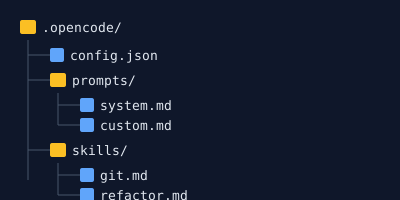
The `AGENTS.md` file sits at the repository root and describes your codebase conventions:
```markdown
# AGENTS.md
## Project Overview
- Framework: Next.js 14 with App Router
- Styling: Tailwind CSS
- Testing: Vitest
## Build Commands
- `npm run build` - Production build
- `npm run test` - Run test suite
- `npm run lint` - Lint code
## Code Style
- Use TypeScript strict mode
- Prefer named exports
- Component files: PascalCase
```text
### Environment Variables
OpenCode respects several environment variables:
```bash
# API Configuration
OPENCODE_API_KEY # Default API key
OPENCODE_PROVIDER # Default provider (openai, anthropic)
OPENCODE_MODEL # Default model
# Behavior
OPENCODE_MAX_TOKENS # Maximum response tokens
OPENCODE_TEMPERATURE # Response randomness (0-1)
OPENCODE_LOG_LEVEL # Logging verbosity
# Project
OPENCODE_PROJECT_ROOT # Override project detection
```text
### Custom Prompts and Templates
Create reusable prompt templates in `.opencode/prompts/`:
```markdown
<!-- .opencode/prompts/review.md -->
Review the following code changes for:
1. **Correctness**: Does the code do what it claims?
2. **Security**: Are there any vulnerabilities?
3. **Performance**: Any obvious bottlenecks?
4. **Style**: Does it match project conventions?
Focus on actionable feedback with specific line references.
```text
Invoke custom prompts:
```bash
opencode --prompt review --input changes.diff
```text
### MCP Server Integration
Model Context Protocol (MCP) servers extend OpenCode with external capabilities. Configure MCP servers in your config:
```json
{
"mcpServers": {
"filesystem": {
"command": "mcp-filesystem",
"args": ["/path/to/project"]
},
"github": {
"command": "mcp-github",
"env": {
"GITHUB_TOKEN": "${GITHUB_TOKEN}"
}
}
}
}
```text
## Superpowers Skills System
### What are Superpowers Skills
Superpowers skills are pre-built workflows that guide OpenCode through complex, multi-step processes. Each skill encapsulates best practices and ensures consistent, high-quality outcomes.
Skills work by injecting detailed instructions into the agent context before it begins work. This gives the agent a roadmap to follow rather than improvising.
### Built-in Skills Overview
#### superpowers/using-superpowers
The meta-skill that teaches how to discover and invoke other skills. Load this first when exploring available capabilities.
**When to use**: Starting any new conversation or when you need to understand what skills exist.
```bash
# The agent loads this automatically at conversation start
opencode "Help me understand what skills are available"
```text
#### superpowers/writing-plans
Guides creation of detailed implementation plans before writing code. Plans break work into atomic steps with clear acceptance criteria.
**When to use**: Any feature request or bug fix that requires multiple steps.
**Workflow**:
1. Gather requirements and context
2. Identify affected files and components
3. Break into atomic, sequential steps
4. Define verification criteria for each step
5. Review plan with user before execution
#### superpowers/test-driven-development
Enforces strict TDD discipline: write tests first, then implement.
**When to use**: Implementing new features or fixing bugs where tests add value.
**Workflow**:
1. Write a failing test that describes desired behavior
2. Run test to confirm it fails for the right reason
3. Write minimal code to make test pass
4. Refactor while keeping tests green
5. Repeat for next requirement
```bash
opencode "Add a user registration feature using TDD"
```text
#### superpowers/systematic-debugging
Provides structured approach to finding and fixing bugs without guessing.
**When to use**: Any unexpected behavior, test failure, or error condition.
**Workflow**:
1. Reproduce the issue reliably
2. Gather diagnostic information (logs, stack traces)
3. Form a hypothesis about root cause
4. Design a test to validate hypothesis
5. Implement fix
6. Verify fix resolves original issue
7. Check for similar issues elsewhere
#### superpowers/verification-before-completion
Ensures work is actually complete before claiming success.
**When to use**: Before marking any task as done, before commits, before PRs.
**Checks**:
1. All modified files pass linting
2. All tests pass
3. No TypeScript errors
4. Build succeeds
5. Manual verification of changed behavior
#### superpowers/writing-skills
Guides creation of new custom skills for your project.
**When to use**: You find yourself repeating a workflow that could be standardized.
**Structure of a skill**:
```markdown
# Skill Name
## When to Use
[Trigger conditions]
## Prerequisites
[Required setup or state]
## Steps
1. [First step with specifics]
2. [Second step with specifics]
...
## Verification
[How to confirm success]
## Rollback
[How to undo if needed]
```text
#### superpowers/using-git-worktrees
Creates isolated git worktrees for parallel development without context switching.
**When to use**: Starting feature work that needs isolation from your current branch.
**Workflow**:
1. Create worktree in isolated directory
2. Checkout target branch in worktree
3. Perform work in isolation
4. Complete and push from worktree
5. Remove worktree when done
```bash
opencode "Create a worktree for the auth feature"
```text
#### superpowers/subagent-driven-development
Coordinates multiple parallel tasks using background agents.
**When to use**: Large features that can be decomposed into independent parts.
**Workflow**:
1. Decompose work into independent tasks
2. Spawn background agents for each task
3. Monitor progress and gather results
4. Integrate completed work
5. Verify integration
### How to Invoke Skills
Skills load automatically based on trigger keywords, or you can explicitly request them:
```bash
# Implicit invocation via trigger words
opencode "Debug the login issue" # triggers systematic-debugging
# Explicit invocation
opencode "Use the TDD skill to add password reset"
```text
### Creating Custom Skills
Place custom skills in `.opencode/skills/`:
```markdown
<!-- .opencode/skills/deploy.md -->
# Deploy to Production
## When to Use
Deploying code to production environment.
## Prerequisites
- All tests passing
- Code reviewed and approved
- CHANGELOG updated
## Steps
1. Run full test suite
2. Build production bundle
3. Create git tag with version
4. Push tag to remote
5. Trigger CI/CD pipeline
6. Monitor deployment health
7. Verify in production
## Verification
- Application loads at production URL
- Health check endpoint returns 200
- No errors in production logs
```text
## Agent Categories
OpenCode routes requests to specialized agents based on task characteristics.
### visual-engineering
Frontend-focused work including UI components, styling, layouts, and visual polish.
**Best for**:
- React/Vue/Svelte component development
- CSS and styling tasks
- Layout fixes and responsive design
- Accessibility improvements
- Animation and interaction design
```bash
opencode "Fix the header alignment on mobile" --category visual-engineering
```text
### ultrabrain
Logic-heavy tasks requiring deep reasoning and algorithmic thinking.
**Best for**:
- Complex algorithm implementation
- Architecture decisions
- Performance optimization
- Security-critical code
- Concurrency and parallelism
```bash
opencode "Optimize the database query that's causing timeouts" --category ultrabrain
```text
### deep
Goal-oriented autonomous problem-solving. The agent works independently toward a defined goal.
**Best for**:
- Large refactoring projects
- Migration tasks
- Multi-file feature implementation
- Research and exploration
```bash
opencode "Migrate the authentication system from JWT to OAuth" --category deep
```text
### artistry
Creative problem-solving with emphasis on elegant solutions and code aesthetics.
**Best for**:
- API design
- Code architecture
- Developer experience improvements
- Library and framework code
```bash
opencode "Design a clean API for the plugin system" --category artistry
```text
### quick
Trivial tasks and single-file changes that need no planning.
**Best for**:
- Typo fixes
- Single function changes
- Configuration updates
- Quick documentation updates
```bash
opencode "Fix the typo in the README" --category quick
```text
### unspecified-low
Lower effort tasks that don't fit other categories.
**Best for**:
- Minor bug fixes
- Small feature additions
- Code cleanup
### unspecified-high
Higher effort tasks requiring substantial work but without special focus.
**Best for**:
- Medium-sized features
- Moderate refactoring
- Multi-step changes
### writing
Documentation, prose, and content creation.
**Best for**:
- README files
- API documentation
- Blog posts
- Code comments and JSDoc
- Changelog entries
```bash
opencode "Write documentation for the webhook API" --category writing
```text
## Available Tools Reference
OpenCode agents access your system through a comprehensive toolset.
### File Operations
**Read** - Read file or directory contents
```text
Parameters: filePath (absolute path), offset, limit
Returns: File contents with line numbers
```text
**Write** - Create or overwrite files
```text
Parameters: filePath, content
Note: Overwrites existing files completely
```text
**Edit** - Make precise string replacements
```text
Parameters: filePath, oldString, newString, replaceAll
Note: Requires exact match, fails on ambiguity
```text
**Glob** - Find files by pattern
```text
Parameters: pattern (glob syntax), path
Returns: Matching file paths sorted by modification time
```text
**Grep** - Search file contents
```text
Parameters: pattern (regex), include (file filter), path
Returns: Matching files with context
```text
### Code Analysis (LSP Tools)
**lsp_goto_definition** - Jump to symbol definition
```text
Parameters: filePath, line, character
Returns: Location where symbol is defined
```text
**lsp_find_references** - Find all usages
```text
Parameters: filePath, line, character, includeDeclaration
Returns: All locations where symbol is used
```text
**lsp_symbols** - Get document or workspace symbols
```text
Parameters: filePath, scope (document/workspace), query
Returns: Symbol outline or search results
```text
**lsp_diagnostics** - Get errors and warnings
```text
Parameters: filePath, severity (error/warning/hint/all)
Returns: Diagnostic items with positions
```text
**lsp_rename** - Rename symbol across workspace
```text
Parameters: filePath, line, character, newName
Note: Use lsp_prepare_rename first to validate
```text
### AST Operations
**ast_grep_search** - AST-aware code pattern matching
```text
Parameters: pattern, lang, paths, globs
Supports meta-variables: $VAR (single node), $$$ (multiple)
```text
**ast_grep_replace** - AST-aware code transformation
```text
Parameters: pattern, rewrite, lang, dryRun
```text
### Shell Operations
**Bash** - Execute shell commands
```text
Parameters: command, workdir, timeout, description
Note: Commands run in persistent shell session
```text
**interactive_bash** - Interactive TUI applications
```text
Parameters: tmux_command
Note: Uses tmux for interactive programs
```text
### Web Tools
**webfetch** - Fetch and parse web content
```text
Parameters: url, format (markdown/text/html), timeout
```text
**google_search** - Search the web with citations
```text
Parameters: query, urls (optional), thinking
```text
**websearch_web_search_exa** - High-quality web search
```text
Parameters: query, numResults, contextMaxCharacters
```text
### Git Operations
All git tools mirror git CLI commands:
- **git_git_status** - Working tree status
- **git_git_diff_unstaged** - Unstaged changes
- **git_git_diff_staged** - Staged changes
- **git_git_diff** - Branch/commit differences
- **git_git_commit** - Create commit
- **git_git_add** - Stage files
- **git_git_reset** - Unstage all
- **git_git_log** - Commit history
- **git_git_create_branch** - Create branch
- **git_git_checkout** - Switch branches
- **git_git_show** - Show commit contents
- **git_git_branch** - List branches
### Session Management
**session_list** - List all sessions
```text
Parameters: limit, from_date, to_date
```text
**session_read** - Read session messages
```text
Parameters: session_id, limit, include_todos
```text
**session_search** - Search session content
```text
Parameters: query, session_id, limit
```text
**session_info** - Get session metadata
```text
Parameters: session_id
```text
### Background Tasks
**call_omo_agent** - Spawn background agent
```text
Parameters: subagent_type, prompt, description, run_in_background
Types: explore, librarian, oracle, hephaestus, metis, momus
```text
**background_output** - Get task output
```text
Parameters: task_id, block, full_session
```text
**background_cancel** - Cancel running task
```text
Parameters: taskId, all
```text
### MCP Integrations
**skill_mcp** - Invoke MCP server operations
```text
Parameters: mcp_name, tool_name, resource_name, arguments
```text
**Ableton MCP** - Music production automation
```text
Tools: ableton-mcp-server_* for session control, tracks, clips, devices
```text
**Blender MCP** - 3D creation automation
```text
Tools: blender_* for scene manipulation, rendering, asset import
```text
**Chrome DevTools MCP** - Browser automation
```text
Tools: chrome-devtools_* for navigation, screenshots, console
```text
## Slash Commands
Built-in commands provide shortcuts for common workflows.
### /init-deep
Initializes a hierarchical AGENTS.md knowledge base for your project.
```bash
opencode /init-deep
```text
This analyzes your codebase structure and generates a comprehensive AGENTS.md with:
- Project architecture overview
- Build and test commands
- Code style conventions
- File organization patterns
### /ralph-loop
Starts a self-referential development loop that continues until completion.
```bash
opencode /ralph-loop "Implement user authentication"
```text
The loop:
1. Creates a plan
2. Executes first step
3. Evaluates progress
4. Adjusts plan if needed
5. Continues until done
### /ulw-loop
Ultrawork loop mode for maximum productivity on well-defined tasks.
```bash
opencode /ulw-loop "Refactor the API handlers"
```text
Emphasizes speed and throughput for routine work.
### /cancel-ralph
Cancels an active Ralph Loop.
```bash
opencode /cancel-ralph
```text
Use when a loop has gone off track or you need to regain control.
### /refactor
Intelligent refactoring with LSP analysis, AST transformations, and verification.
```bash
opencode /refactor "Extract the validation logic into separate module"
```text
Workflow:
1. Analyzes current code structure
2. Identifies dependencies via LSP
3. Creates refactoring plan
4. Applies AST transformations
5. Runs tests to verify
6. Fixes any issues
### /start-work
Starts a work session from an existing Prometheus plan.
```bash
opencode /start-work --plan feature-auth.md
```text
Loads the plan and begins systematic execution.
### /stop-continuation
Stops all continuation mechanisms (ralph loop, todo continuation, boulder) for the current session.
```bash
opencode /stop-continuation
```text
Use when you need to pause and reassess.
### /handoff
Creates a detailed context summary for continuing work in a new session.
```bash
opencode /handoff > handoff.md
```text
The handoff includes:
- Current task state
- Completed steps
- Remaining work
- Important context and decisions
- File references
## Workflow Examples
### Starting a New Project
```bash
# Initialize OpenCode configuration
opencode /init-deep
# Create initial structure
opencode "Set up a Next.js project with TypeScript, Tailwind, and Vitest"
# Add first feature with TDD
opencode "Add a homepage with a hero section using TDD" --load-skills test-driven-development
# Verify everything works
opencode /refactor "Ensure all imports are consistent"
```text
### TDD Workflow with OpenCode
```bash
# 1. Start with the TDD skill loaded
opencode "Add user login functionality" --category visual-engineering --load-skills test-driven-development
# The agent will:
# - Write a failing test for login form
# - Implement the form component
# - Write a failing test for form submission
# - Implement submission logic
# - Continue until feature complete
```text
### Debugging a Complex Issue
```bash
# Load the debugging skill
opencode "The checkout process fails intermittently" --load-skills systematic-debugging
# The agent will:
# - Reproduce the issue
# - Check logs and error traces
# - Form hypotheses
# - Test each hypothesis
# - Implement and verify fix
```text
### Code Review and Refactoring
```bash
# Get a comprehensive review
opencode "Review the payment processing module for security and performance"
# Apply refactoring
opencode /refactor "Simplify the error handling in payment processing"
# Verify with tests
opencode "Run all tests related to payments and ensure they pass"
```text
### Multi-Agent Parallel Development
```bash
# Decompose a large feature
opencode "We need to add a dashboard with charts, data tables, and filters"
# Agent might spawn background tasks:
# - Task 1: Build chart components
# - Task 2: Build data table with sorting
# - Task 3: Implement filter logic
# Then integrate all pieces
```text
## Best Practices
### Prompt Engineering for OpenCode
**Be specific about scope**:
```text
Good: "Add a validation function for email addresses in utils/validation.ts"
Bad: "Add email validation"
```text
**Provide context**:
```text
Good: "In the context of the user registration flow, add password strength validation"
Bad: "Validate passwords"
```text
**Specify constraints**:
```text
Good: "Add the feature without adding new dependencies"
Bad: "Add the feature"
```text
**Request verification**:
```text
Good: "Add the feature and run the related tests to verify"
Bad: "Add the feature"
```text
### Effective Skill Usage
- Load relevant skills at the start of complex tasks
- Let skills guide the workflow rather than micromanaging
- Trust the skill's process even when it seems verbose
- Use verification-before-completion before claiming done
### Session Management Tips
- Keep related work in the same session for context
- Use session search to find past solutions
- Create handoffs when switching between major tasks
- Review session history to understand what was tried
### Context Window Optimization
- Close irrelevant files before starting
- Use specific file paths rather than broad searches
- Let OpenCode manage which files it needs to read
- Break large tasks into smaller, focused sessions
## Troubleshooting
### Common Issues and Solutions
**Agent loses context mid-task**:
- Break the task into smaller pieces
- Use handoffs to preserve state
- Restart with a fresh session and handoff file
**Skills not loading**:
- Check `.opencode/skills/` directory exists
- Verify skill files have correct format
- Look for syntax errors in skill markdown
**Tools failing with permission errors**:
- Check file permissions
- Verify working directory is correct
- Ensure API keys are set
**Unexpected behavior**:
- Check AGENTS.md for conflicting conventions
- Review session history for context
- Use `/stop-continuation` to reset state
### Debugging OpenCode Behavior
Enable verbose logging:
```bash
OPENCODE_LOG_LEVEL=debug opencode "your prompt"
```text
Check tool invocations in the session output to see exactly what OpenCode is doing.
### Reset and Recovery
**Reset a session**:
```bash
opencode "Reset the current task and start fresh"
```text
**Recover from bad state**:
```bash
opencode /stop-continuation
opencode "Undo the last change and explain what went wrong"
```text
**Full reset**:
```bash
rm -rf ~/.opencode/sessions/*
opencode "Start fresh"
```text
---
OpenCode transforms development from a manual process into a collaborative partnership with AI. By understanding its tools, skills, and best practices, you can leverage its full potential while maintaining control over your codebase.
## Next Steps
- [World Office](/world-office/) — Explore the future of distributed, AI-powered work environments
- [Prompting Techniques for Agentic AI](/articles/ai/prompting-techniques-for-agentic-ai/) — Master prompt engineering for autonomous systems
- [Agentic AI Presentation](/articles/ai/agentic-ai-presentation/) — Slide deck on practical agentic coding workflows