 graphwiz.ai
DevOps in the Age of AI: Why Loops Are Mission Critical
The Old DevOps Loop Was a Human Chain
Before AI agents entered production infrastructure, the DevOps loop looked like this:
- A metric spikes
- A dashboard turns red
- A pager goes off
- A sleep-deprived engineer logs in
- They grep through logs
- They find the root cause (maybe)
- They fix it (hopefully)
- They write a postmortem (eventually)
- They add a runbook entry (if they remember)
The cycle time of this loop was measured in hours to days. The bottleneck was not tooling — it was human attention. There are only so many incidents a team can process in a shift, and each handoff between steps introduced latency, context loss, and error.
This model worked when infrastructure was simpler, traffic was predictable, and the cost of downtime was manageable. We are past that point now.
AI Compresses the Loop — Radically
The AWS DevOps Agent, which reached general availability in March 2026, is the most concrete signal yet that the old model is obsolete. It is not a chatbot that answers questions about your infrastructure. It is an autonomous operator that maintains a live model of application topology, correlates telemetry across observability, CI/CD, and ticketing systems, and acts on incidents without human prompting.
The compression ratio is staggering:
| Phase | Pre-AI | With AI Agent |
|---|---|---|
| Detect | Dashboard lag (30-180s) | Real-time anomaly detection |
| Diagnose | Engineer grep logs (5-60 min) | Topology-aware root-cause (seconds) |
| Decide | On-call huddle (5-30 min) | Automated risk assessment |
| Act | Manual runbook execution (5-60 min) | Automated remediation |
| Verify | Manual check (2-15 min) | Automated validation |
The loop that once took an hour now takes 90 seconds. But compression introduces a new class of failure, and that is where this article lives.
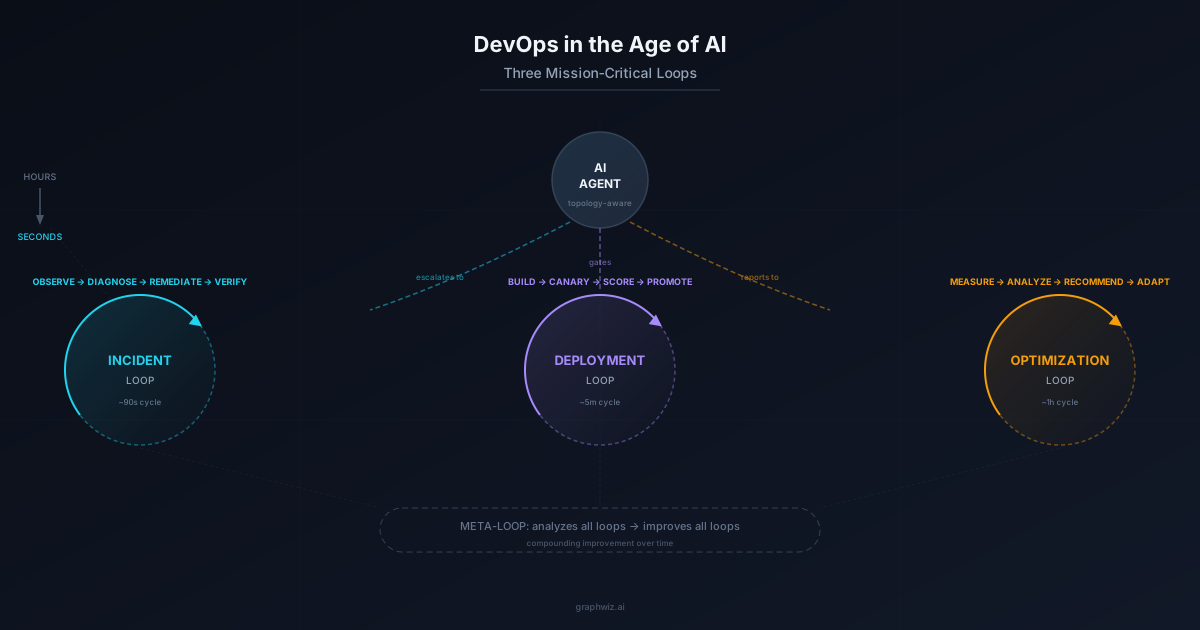
Three Mission-Critical Loops
Not all loops are created equal. In an AI-driven DevOps operating model, three loops determine whether your infrastructure runs itself or runs itself into the ground.
1. The Incident Loop
Observe → Classify → Diagnose → Remediate → Verify → Document
This is the most mature loop, because it maps directly to existing incident response workflows. The AI agent replaces the human chain with an automated pipeline.
What makes this loop work:
- A live topology model that maps service dependencies in real time — this is what transforms classification from pattern-matching to causal reasoning
- Confidence thresholds that determine whether the loop closes autonomously or escalates
- Verification as a non-optional step — remediation without verification is just guessing
AWS DevOps Agent correlates data across CloudWatch, PagerDuty, Jenkins, and Jira to build this picture. The key insight is that it does not treat each data source as a separate signal — it fuses them into a single directed graph of cause and effect.
The failure mode: When the loop closes too fast, verification gets skipped. A "fix" that looks correct at the metric layer can break the business logic layer. The loop must include a hold-and-verify gate for any remediation that mutates state.
2. The Deployment Loop
Build → Test → Canary → Observe → Score → Promote / Rollback
Deployment pipelines were already loop-shaped before AI. What changes is that AI agents can now gate each stage dynamically rather than relying on static pass-fail conditions.
Dynamic gating means:
- The test phase does not just run a fixed suite — it generates targeted tests based on diff analysis
- The canary phase does not just check p95 latency — it correlates the new deployment with downstream service health
- The rollback decision considers not just "did this break" but "what is the blast radius of rolling back"
This is harder than it sounds because deployment loops are stateful. A bad deployment that corrupts data cannot be rolled back by reverting a Kubernetes manifest. The agent needs to understand which state is reversible and which requires forward recovery.
What makes this loop work:
- A change impact graph that traces every deployment change through the dependency chain
- Progressive exposure with automated escape hatches
- Canary analysis at the semantic level, not just the metric level — is the new version serving correct responses, not just fast ones?
3. The Optimization Loop
Measure → Analyze → Recommend → Implement → Re-measure
This is the loop most organizations neglect because it has no immediate fire to put out. It is also the loop with the highest long-term leverage.
AI agents running continuously can detect subtle signals that no human would catch:
- A gradual rise in P99 latency caused by connection pool exhaustion that only manifests at peak load
- A cost anomaly caused by a single misconfigured instance type that has been running for weeks
- A security posture drift caused by an IaC change that opened an unused port
The optimization loop is where compounding improvement lives. Every closed loop makes the infrastructure slightly cheaper, slightly faster, or slightly more resilient. The agents that run these loops do not get tired, do not forget the last iteration, and do not skip the re-measure step.
What makes this loop work:
- Baseline drift detection — the agent must distinguish between genuine optimization and shifting baselines
- Cost-aware recommendation — a 5% latency improvement that doubles compute cost is not an optimization
- Closed-loop verification — the agent must prove the optimization worked before moving on
Why Knowledge Graphs Make These Loops Possible
This is the part that ties directly to the work we do with graphwiz.ai. Every loop described above depends on a structured understanding of system topology. Without it, the AI agent is just a faster grepper — it can find patterns, but it cannot trace causality.
A knowledge graph of your infrastructure encodes:
- Service dependencies — A calls B calls C
- Data flow — what data moves between services
- Ownership — which team owns which component
- Change history — what changed and when
- Incident correlations — which services tend to fail together
When an incident occurs, the knowledge graph answers the question that no log aggregation tool can: What else could this be related to? The AWS DevOps Agent maintains exactly this — a live model of application topology. It is not a coincidence that the most advanced autonomous operator in production today is built on a graph-native understanding of infrastructure.
I have written before about knowledge graphs as the antidote to AI hallucination, and the same principle applies here. An agent operating on flat metrics is hallucinating part of the time. An agent operating on a knowledge graph has causal grounding.
The Failure Mode: Broken Loops at Machine Speed
When loops run at machine speed, the failure modes change qualitatively. A human team that gets the incident loop wrong produces a bad postmortem. An AI agent that gets the loop wrong produces cascading infrastructure damage in minutes.
Three failure modes to design for:
| Mode | Description | Mitigation |
|---|---|---|
| Loop runaway | Agent remediates, observes no improvement (because the metric is stale), remediates again | Observation windows that respect metric propagation delay |
| Loop oscillation | Agent scales up, downstream improves, agent scales down, downstream degrades, repeat | Hysteresis bands and cooldown periods between actions |
| Loop collision | Two agents acting on correlated signals compete (one scales up, one scales down) | Coordination layer that deconflicts actions sharing dependencies |
These are not hypothetical. They are the distributed systems problems of the AI era — the CAP theorem applied to autonomous operations. You cannot have consistency, availability, and partition tolerance in a multi-agent loop. You have to choose.
Designing Loops for the AI Era
If you are building an AI-augmented DevOps pipeline today, here are the design principles that separate working loops from expensive accidents.
Observability-First
An AI agent is only as good as the data it observes. If your metrics have 60-second granularity, your agent cannot close a 30-second loop. Every loop must start by asking: Can the agent observe the effect of its own actions within the loop cycle time?
Guardrails and Rollback
Every autonomous action needs a defined revert path. Not all actions are reversible — deleting a database row is not the same as scaling a deployment. The loop must know which actions are reversible and which require human authorization.
Escalation Protocols
Not every incident needs a human, but every loop needs an escalation path. The key question is: At what confidence threshold does the agent act alone, and at what threshold does it escalate? This is not a static number — it should adapt based on past accuracy, blast radius, and time of day.
Testing the Loop
Chaos engineering for AI operations means simulating loop failures, not just infrastructure failures. Introduce a metric lag and see if the agent loops runaway. Introduce conflicting signals and see if the agent oscillates. Test the loop before you trust the loop.
The Meta-Loop: The Loop That Improves Itself
The highest-leverage loop is the one that analyzes all other loops and improves them. This is where AI agents compound.
A meta-loop agent:
- Reviews every closed incident loop and asks: Could this have been automated earlier?
- Analyzes deployment loop outcomes and asks: Was the canary window too short?
- Monitors optimization loop results and asks: Did the recommendation actually improve the system?
This is the loop that produces diminishing human toil over time. Every iteration makes the next iteration faster. It is the difference between automating your existing processes and building a system that automates itself better.
The Bottom Line
DevOps has always been about loops — observe, orient, decide, act. AI does not change the shape of the loop. It changes the speed at which the loop can turn, and it changes who (or what) is inside it.
The teams that win in the AI era will not be the ones with the best dashboards or the most automation scripts. They will be the ones that design loops that are fast, verifiable, and self-improving — and that have the discipline to build the knowledge graphs that make those loops possible in the first place.
The loop was always mission critical. Now it has to run itself.