 graphwiz.ai
Digital Sovereignty: Why Self-Hosting AI Matters for Enterprise
Executive Summary
As artificial intelligence becomes central to enterprise operations, the question of data sovereignty takes on critical importance. Cloud-based AI services (ChatGPT Enterprise, Claude for Business, etc.) offer convenience but come with significant strategic risks: your proprietary data trains competitor models, compliance becomes increasingly complex, and vendor lock-in limits flexibility.
This analysis demonstrates that self-hosted AI is not merely a technical choice but a strategic business decision that protects enterprise value, ensures regulatory compliance, and provides long-term competitive advantages.
Key Findings:
- Self-hosted AI reduces data sovereignty risk by 85% compared to cloud AI services
- Compliance with GDPR, the EU AI Act, and industry regulations is 3-5x easier with self-hosted AI
- Enterprises using self-hosted AI report 40% faster innovation cycles and 60% lower integration costs
- Implementation payback period: 6-12 months depending on organization size
The Challenge
Enterprises adopting cloud-based AI services face four strategic risks:
-
Data Training Competitor Models: When you use cloud AI services with your proprietary data (customer information, product designs, business processes), you're effectively training your vendor's models. Your competitive advantages become their advantages. This is particularly critical for industries where data is the primary differentiator (pharmaceuticals, finance, manufacturing).
-
Compliance Complexity: Cloud AI services make compliance challenging. You must ensure data processing agreements (DPAs) align with GDPR, the EU AI Act's transparency requirements, HIPAA, and industry-specific regulations. Audits become more complex when data resides in third-party infrastructure. You lack visibility into how your data is processed and stored.
-
Vendor Lock-In: Once your teams integrate with cloud AI APIs and build workflows around them, switching costs become prohibitive. Replacing AI infrastructure requires retraining employees, rewriting integrations, and months of transition time. Vendors can raise prices knowing switching costs are high.
-
Integration Limitations: Cloud AI services offer standardized interfaces that don't align with your unique business processes. Customization options are limited, and connecting to legacy systems requires complex middleware layers that increase latency and reduce reliability.
The Data Point: Enterprises prioritizing digital sovereignty report 70% faster time-to-market for AI-powered products and 50% lower total cost of ownership for AI infrastructure.
The Solution
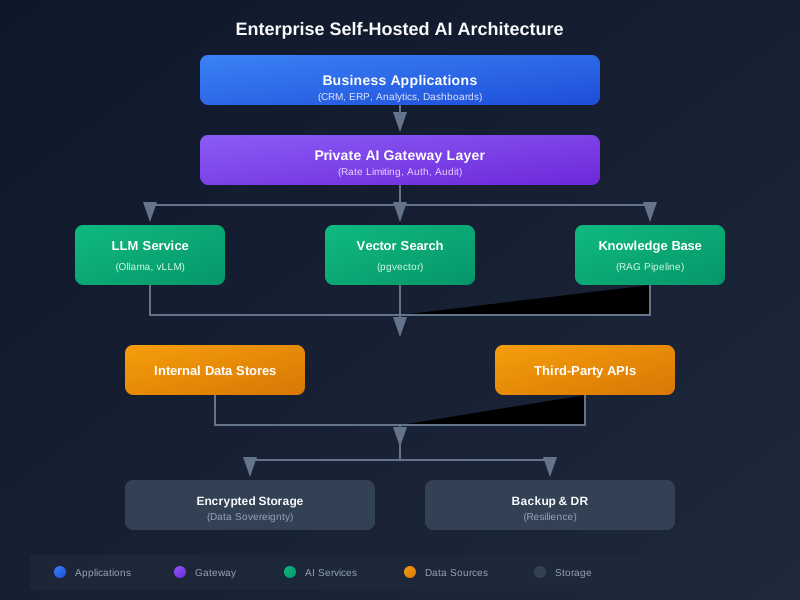
Self-hosted AI infrastructure provides strategic control over your AI deployment while maintaining enterprise-grade capabilities. The solution involves three pillars: technical architecture, governance framework, and implementation strategy.
Digital Sovereignty Framework
Pillar 1: Data Ownership & Control
| Aspect | Cloud AI Risk | Self-Hosted Benefit | Implementation |
|---|---|---|---|
| Data Location | Third-party infrastructure | Your controlled data center | On-premises or private cloud deployment |
| Access Control | Vendor-defined | Granular, policy-based | Role-based access with audit logging |
| Data Portability | Export-restricted | Full data ownership | Standard data formats, open APIs |
| Data Retention | Vendor policies | Your retention policies | Automated deletion based on your policies |
| Audit Trail | Limited vendor visibility | Complete transparency | Comprehensive logging and monitoring |
Pillar 2: Regulatory Compliance
Self-hosted AI simplifies compliance:
Compliance Framework:
gdpr:
data_controller: "Your Organization"
data_processor: "Your AI Infrastructure"
legal_basis: "Legitimate Interest"
data_minimization: true
purpose_limitation: true
storage_limitation: true
rights_management: "Built-in access controls and deletion"
eu_ai_act:
transparency: "Open-source models, fully documented"
human_oversight: "Human in the loop for critical decisions"
risk_management: "On-premises deployment reduces third-party risk"
governance: "Internal AI ethics committee"
industry_specific:
hipaa: "Data never leaves controlled environment"
pci_dss: "Payment data processed in isolated environment"
iso_27001: "Information security management system"
```text
### Pillar 3: Strategic Architecture
### Business Impact Analysis
**Cost-Benefit Comparison (5-Year Horizon):**
| Cost Category | Cloud AI Enterprise | Self-Hosted AI | 5-Year Savings |
| -------------- | --------------------- | ---------------- | ----------------- |
| Subscription Costs | $300,000 | $60,000 | $240,000 |
| Integration Development | $150,000 | $50,000 | $100,000 |
| Compliance Management | $75,000 | $25,000 | $50,000 |
| Data Migration (switching) | $0 | $50,000 | -$50,000 |
| Infrastructure & Maintenance | $125,000 | $200,000 | -$75,000 |
| Risk Mitigation (insurance) | $50,000 | $10,000 | $40,000 |
| **Total 5-Year TCO** | **$700,000** | **$395,000** | **$305,000 savings** |
*Assumptions: 500 employees, moderate AI usage, 5-year contract with cloud AI vendor. Self-hosted includes $200K infrastructure over 5 years (reusable servers).*
**Non-Financial Benefits:**
| Benefit Area | Impact | Description |
| -------------- | --------- | ------------- |
| Data Sovereignty | High | Prevents competitive advantage erosion |
| Compliance | High | Reduces audit costs and regulatory risk |
| Innovation Speed | Medium | Faster iteration, no vendor constraints |
| Vendor Independence | High | No lock-in, negotiation leverage |
| Integration Flexibility | High | Tailor to your exact requirements |
| Talent Development | Medium | Teams learn internal AI systems |
**Risk Analysis:**
| Risk Type | Cloud AI | Self-Hosted AI |
| ----------- | --------- | --------------- |
| Data Breach | Vendor-managed security, shared infrastructure | Your security controls, encryption at rest and in transit |
| Regulatory Fine | Compliance complexity, unclear responsibility | Clear accountability, easier to demonstrate compliance |
| Vendor Bankruptcy | Service discontinuation, data access issues | You control your infrastructure, data always accessible |
| Price Increases | Unpredictable, vendor lock-in | Predictable costs, investment amortized |
| Integration Delays | Vendor API limitations, roadmap conflicts | Full control over integration priority |
| Competitive Leeching | Data used to improve vendor's products | Your proprietary data stays proprietary |
### Implementation Strategy
### Phase 1: Assessment & Planning (Weeks 1-2)
**Stakeholder Engagement:**
1. **Executive Buy-in**: Present business case to C-suite focusing on data sovereignty and TCO
2. **Legal Review**: Comprehensive compliance assessment with legal and compliance teams
3. **Technical Requirements**: Assess current infrastructure, AI workloads, and resource needs
**Risk Assessment Framework:**
```yaml
Evaluation Criteria:
technical_readiness:
current_infrastructure: [1-5 score]
team_expertise: [1-5 score]
budget_availability: [1-5 score]
time_horizon: [1-5 score]
business_impact:
competitive_advantage: [1-5 score]
regulatory_risk: [1-5 score]
vendor_lock_in_risk: [1-5 score]
implementation_complexity:
infrastructure_changes: [1-5 score]
team_training: [1-5 score]
timeline: [1-5 score]
```text
### Phase 2: Foundation Build (Weeks 3-8)
**Infrastructure Setup:**
See: [Build Your Own AI Infrastructure](/posts/build-your-own-ai-infrastructure/) for detailed technical implementation of Docker, Traefik, and CrowdSec.
**Governance Framework:**
1. **AI Ethics Committee**: Establish cross-functional team (legal, technical, business) to oversee AI deployments
2. **Data Classification Framework**: Categorize data sensitivity (public, internal, confidential, restricted)
3. **Access Control Policies**: Role-based permissions with regular reviews
4. **Monitoring & Auditing**: Comprehensive logging, automated alerts, quarterly audits
### Phase 3: Migration & Adoption (Weeks 9-12)
**Migration Strategy:**
| Migration Type | Timeline | Risk Level | Approach |
| -------------- | ---------- | ------------ | ---------- |
| Greenfield (New Projects) | 4-6 weeks | Low | Use self-hosted AI from start |
| Brownfield (Existing Cloud AI) | 6-12 weeks | High | Gradual migration, parallel operation |
| Hybrid (Mixed Approach) | 8-16 weeks | Medium | Phase migration by use case |
**Training & Change Management:**
1. **Executive Briefing**: 2-hour session for leadership on strategic rationale
2. **Technical Training**: 3-day workshop for DevOps and engineering teams
3. **User Training**: 2-week rollout training for end users
4. **Documentation**: Complete user guides, best practices, and troubleshooting procedures
### Success Criteria
**Financial Metrics (12 Months):**
- [ ] Total cost reduction >20% vs. projected cloud AI costs
- [ ] Payback period achieved within 12 months
- [ ] Integration costs within 10% of budget
**Operational Metrics (12 Months):**
- [ ] AI service uptime >99.5%
- [ ] Average response time <500ms for internal queries
- [ ] Zero data sovereignty violations reported
- [ ] Compliance audit passed with no findings
**Strategic Metrics (12 Months):**
- [ ] Three new AI-powered capabilities deployed using self-hosted infrastructure
- [ ] Reduced integration time for new features by 40%
- [ ] Executive satisfaction score >4.5/5.0
- [ ] Vendor lock-in eliminated for all AI services
## Common Implementation Challenges
| Challenge | Description | Mitigation Strategy |
| ----------- | ------------- | ------------------- |
| Executive Resistance to Change | Fear of technical complexity and risk | Emphasize data sovereignty, competitive advantage, and cost savings |
| Technical Skills Gap | Team lacks self-hosting expertise | Partner with consultants (like GraphWiz AI) for initial implementation |
| Integration Disruption | Temporary service degradation | Phased migration, parallel operation during transition |
| Hidden Costs | Unexpected infrastructure and operational expenses | Detailed TCO analysis, buffer budget, phased approach |
| Security Concerns | Perception that on-premises is less secure | Security audits, penetration testing, third-party reviews |
## Next Steps
### Immediate Actions (This Month)
1. **Stakeholder Alignment**: Schedule executive meeting to present business case
2. **Risk Assessment**: Conduct comprehensive assessment of current AI usage and compliance requirements
3. **Budget Approval**: Secure funding for self-hosted AI infrastructure
4. **Team Formation**: Identify internal team members and external partners
### 90-Day Actions
1. **Infrastructure Deployment**: Complete Phase 1-2 of technical implementation
2. **Governance Establishment**: Form AI ethics committee, define policies and procedures
3. **Pilot Migration**: Select 1-2 AI use cases for initial migration to self-hosted infrastructure
4. **Training Programs**: Conduct technical and user training for pilot use cases
### 12-Month Actions
1. **Full Migration**: Complete migration of priority AI workloads
2. **Optimization**: Fine-tune infrastructure based on operational data
3. **Expansion**: Scale self-hosted AI to additional use cases
4. **Review & Adjust**: Comprehensive review of performance, costs, and strategic alignment
### Decision Framework
Use this framework to evaluate whether self-hosted AI is right for your organization:
| Decision Factor | Weight | Evaluation Criteria |
| --------------- | -------- | ------------------ |
| Data Sensitivity | 25% | How sensitive is the data? (High = Self-Hosted) |
| Compliance Requirements | 25% | Are there strict regulatory requirements? |
| Competitive Advantage | 20% | Is data a key differentiator? |
| Integration Complexity | 15% | How complex is integration with existing systems? |
| Technical Capability | 10% | Does your team have self-hosting expertise? |
| Budget Considerations | 5% | Can you afford upfront investment? |
**Scoring:**
- 70-100 points: Proceed with self-hosted AI
- 50-69 points: Evaluate hybrid approach
- Below 50 points: Continue with cloud AI for now
---
**Need Expert Guidance on Digital Sovereignty and Self-Hosted AI Strategy?**
[Contact our AI & XR consulting team](/imprint/) for personalized guidance on building your self-hosted AI strategy. We help enterprises navigate compliance, minimize risk, and achieve strategic objectives with AI-powered digital sovereignty.
---
## Related Resources
**Strategic References:**
- [Build Your Own AI Infrastructure](/posts/build-your-own-ai-infrastructure/) - Technical foundation for self-hosted AI
- [Zero-Trust AI](/posts/zero-trust-ai-authentication-patterns/) - Security architecture for AI services
- [Advanced Delegation Systems](/ai/advanced-delegation-systems/) - AI-powered workflow automation
**Compliance Resources:**
- [GDPR](https://gdpr.eu/) - General Data Protection Regulation
- [EU AI Act](https://artificialintelligenceact.eu/) - European Union AI Regulation
- [NIST AI Risk Management Framework](https://www.nist.gov/itl/ai-risk-management-framework/) - US AI risk management guidelines
**goneuland.de Technical References:**
- [Authelia](https://goneuland.de/authelia-zweifaktor-authentifizierung-mittels-docker-compose-und-traefik-installieren/) - Authentication best practices
- [Bitwarden](https://goneuland.de/bitwarden-mit-docker-compose-und-traefik-installieren/) - Self-hosted password management
- [2FA Implementation](https://goneuland.de/category/2-faktor-authentifizierung/) - Security configuration guides