The Problem — Cloud Storage Is Eating Your Budget
AWS S3 is eating your budget. Or you're storing application data, backups, and media on local disk without durability guarantees. Either way, there's a better way.
At 10TB with egress, S3 Standard costs ~$230/month. Self-hosted MinIO on 4x 4TB NVMe drives costs ~$60/month (amortized). The break-even point is approximately 5TB — and every terabyte after that widens the gap.
But self-hosting object storage means setting up MinIO, configuring backup, managing lifecycle policies, and exposing it securely — which is exactly where most people get stuck.
What This Stack Does For You
Self-hosted S3-compatible object storage with automated backup, lifecycle management, and Nginx reverse proxy — one command to deploy, zero AWS bills.
What You'll Be Able To Do After Deploying
- Cut storage costs by 70%+ — MinIO's S3-compatible API means any app that speaks S3 (AWS SDK, boto3, mc, rclone) works without code changes. Drop-in replacement for S3, Backblaze, or Wasabi.
- Store files up to 5GB+ — Nginx reverse proxy configured with large upload buffering so your application data, backups, and media don't hit artificial limits
- Automate backups with one command —
mc mirrorhandles incremental sync to remote S3 or Backblaze B2. Set it and forget it. - Configure data lifecycle in minutes — Bucket lifecycle policies, versioning, and retention rules so old data expires automatically and critical data stays protected
- Scale from dev to production — Start single-node on one machine, add drives for HA, grow to a 4-16 node distributed cluster. MinIO's erasure coding provides RAID-like protection without hardware RAID.
- Manage everything from a web console — No CLI needed for day-to-day monitoring and management
Why This Saves You Hours
DIY self-hosted object storage means:
- Research: Installing MinIO, configuring the Nginx reverse proxy, setting up TLS, creating bucket policies, writing backup scripts
- Backup wiring: Writing
mc mirrorcron jobs, testing incremental sync, configuring lifecycle transitions - Security: TLS termination, rate limiting, access policies — easy to misconfigure, costly when wrong
This stack includes everything pre-configured. Download, extract, run docker compose up -d.
Cost Comparison
For 10TB monthly storage with egress:
| Provider | Monthly Cost | |----------|-------------| | AWS S3 Standard | ~$230 | | MinIO self-hosted (4x 4TB NVMe) | ~$60 (amortized hardware) | | Backblaze B2 | ~$60 |
Self-hosted MinIO breaks even at approximately 5TB and gets cheaper from there.
What You Get
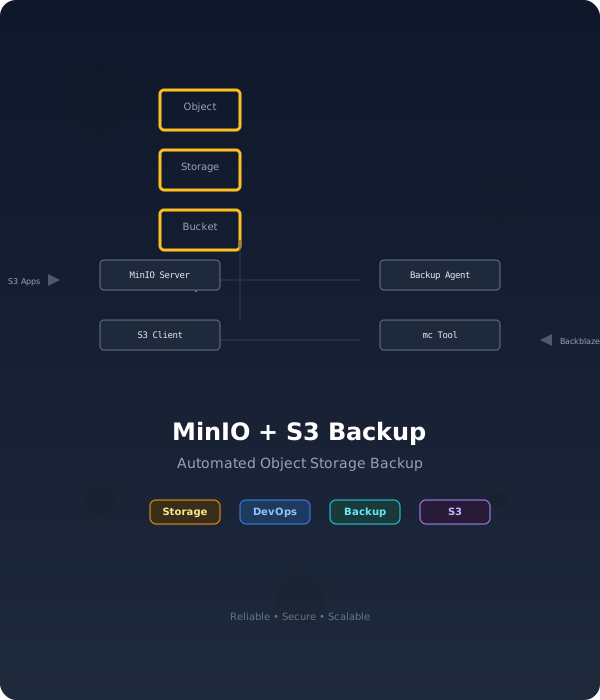
Includes: MinIO Server, Nginx reverse proxy, backup agent, mc client
Components:
- MinIO Server with S3-compatible API — drop-in for AWS S3, Backblaze, Wasabi
- Nginx reverse proxy with TLS, rate limiting, and large upload buffering (5GB+)
- Automated backup to remote S3 using
mc mirror(incremental sync) - Bucket lifecycle policies, versioning, and retention rules
- Web console for management and monitoring
- Health checks and automated recovery
Deployment Modes:
| Mode | Use Case | Nodes | |------|----------|-------| | Single-node standalone | Dev, personal use, <5TB | 1 | | Single-node with drives | Small team, HA storage | 1 + 4 drives | | Distributed cluster | Production, multi-AZ | 4-16 nodes |
The included stack ships as single-node with drives — ready to scale to distributed when needed.
Backup Strategy (pre-configured):
| Frequency | What | |-----------|------| | Hourly | Application data and active files (incremental) | | Daily | Full bucket sync to remote S3 or Backblaze B2 | | Weekly | Lifecycle transition to archival storage | | Monthly | Immutable snapshot for compliance |
Your Outcome
5 minutes from now, you'll have S3-compatible object storage running on your hardware — automated backups, lifecycle management, TLS termination, and a web console. Your apps connect to the S3 API they already speak. Your AWS bill drops by hundreds a month.